
Intel
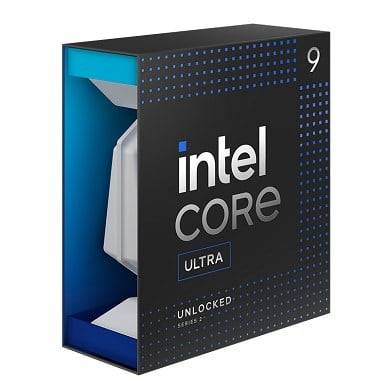
Intel Core Ultra 9 285K Processor 36 MB Smart Cache Box BX80768285K
(No reviews yet)
Write a Review
- UPC:
- 5032037281928
- MPN:
- BX80768285K
- Condition:
- New
- Availability:
- Available with FREE Delivery (usually delivered within 5-7 working days)

Description
Specs
Processor
Processor manufacturer
The manufacturer that produced the processor.
Intel
Processor generation
Intel Core Ultra (Series 2)
Processor model
The model number for the processor in a computer.
285K
Processor family
A family of processors is a group of processors produced by one company over a short period of time e.g. Intel Pentium processors.
Intel Core Ultra 9
Processor cores
The number of central processing units ('cores') in a processor. Some processors have 1 core, others have 2 (e.g. Intel Core Duo) or more (e.g. the Intel Xeon E7-2850 has 10 cores).
24
Processor socket
Mechanical component(s) that provides mechanical and electrical connections between a microprocessor and a printed circuit board (PCB). This allows the processor to be replaced without soldering.
LGA 1851 (Socket V1)
Processor threads
24
Processor operating modes
Operating modes for the processors that place restrictions on the type and scope of operations for certain processes run by the CPU. This design allows the operating system to run with more privileges than application software.
64-bit
Performance cores
8
Efficient cores
Processor boost frequency
The turbo boost is an automatic, managed accelleration of the processor when one of the cores is overloaded.
5.7 GHz
Performance-core boost frequency
5.5 GHz
Performance-core base frequency
3.7 GHz
Efficient-core boost frequency
4.6 GHz
Efficient-core base frequency
3.2 GHz
Processor cache
36 MB
Processor cache type
Smart Cache
Package type
The type of product package e.g. box.
Box
Cooler included
The device comes with an integrated cooler.
Processor base power
5 W
Maximum turbo power
250 W
AI software frameworks supported by CPU
DirectML, OpenVINO, Windows ML, ONNX RT, WebNN
Stepping
B0
Maximum number of DMI lanes
8
Processor codename
Arrow Lake
Processor ARK ID
241060
Neural processor unit (NPU)
Neural processor unit (NPU)
Intel AI Boost
Sparsity support
Windows Studio effects support
AI software frameworks supported by NPU
DirectML, OpenVINO, Windows ML, ONNX RT, WebNN
Total processor performance up to
36 TOPs
NPU performance up to
TOPs
GPU performance up to
8 TOPs
Memory
Maximum internal memory supported by processor
2 GB
Memory types supported by processor
DDR5-SDRAM
Memory clock speeds supported by processor
6400 MHz
Memory channels
Dual-channel
ECC
ECC means Error Correction Code, and it is memory that is able to detect and correct some memory errors without user intervention.
Graphics
On-board graphics card
Graphics hardware which is built into the motherboard or CPU, as opposed to a separate graphics adapter (video card). On-board graphics uses CPU and RAM for graphics processing.
Discrete graphics card
On-board graphics card model
"Graphic adapter" is the hardware that produces images on a display. "On-board" means that the graphics adapter is intergrated inside the motherboard.
Intel Graphics
On-board graphics card outputs supported
HDMI 2.1, Embedded DisplayPort (eDP) 1.4b, DisplayPort 2.1
On-board graphics card base frequency
300 MHz
On-board graphics card dynamic frequency (max)
00 MHz
Number of displays supported (on-board graphics)
The feature may not be available on all computing systems. Functionality, performance, and other benefits of this feature may vary depending on system configuration.
4
On-board graphics card DirectX version
.0
On-board graphics card OpenGL version
4.5
On-board graphics card refresh rate at maximum resolution (DisplayPort)
60 Hz
On-board graphics card refresh rate at maximum resolution (eDP - Integrated Flat Panel)
60 Hz
On-board graphics card refresh rate at maximum resolution (HDMI)
60 Hz
On-board graphics card ID
0x7D67
Discrete graphics card model
A graphics adapter (often known as a video card) generates images for a display. A discrete graphics adapter plugs into the motherboard, and usually produces much better graphics than an integrated graphics adapter. There are various models of discrete graphics adapters.
Not available
Xe-cores
4
Features
Execute Disable Bit
Idle States
Thermal Monitoring Technologies
Features
Market segment
Desktop
Use conditions
Workstation, PC/Client/Tablet
Maximum number of PCI Express lanes
24
PCI Express slots version
4.0, 5.0
Supported instruction sets
AVX 2.0, SSE4.1, SSE4.2
Scalability
1S
Embedded options available
Thermal solution specification
Intel Reference Heat Sink specification for proper operation of this SKU.
PCG 2020A
Direct Media Interface (DMI) Revision
4.0
Export Control Classification Number (ECCN)
5A992C
Commodity Classification Automated Tracking System (CCATS)
740.17B1
Processor special features
Intel® Turbo Boost Technology
Higher Performance When You Need It Most Intel® Turbo Boost Technology 2.0 accelerates processor and graphics performance by increasing the operating frequency when operating below specification limits. The maximum frequency varies depending on workload, hardware, software, and overall system configuration.
2.0
Intel® Quick Sync Video Technology
Create, Edit, and Share Video in a Flash Intel® Quick Sync Video uses the dedicated media processing capabilities of Intel® Graphics Technology to make video encoding tasks—such as creating DVDs or Blu-ray discs, creating and editing 3D videos, converting 2D video files into 3D, and converting video for portable media players and social networking sites—faster and easier.
Intel® AES New Instructions (Intel® AES-NI)
Added Security with Faster Data Encryption The Intel® Advanced Encryption Standard New Instructions (Intel® AES-NI) enable fast and secure data encryption and decryption for better performance and less risk from timing and cache-based attacks than table-based software implementations. Intel AES-NI supports usages such as standard key lengths, standard modes of operation, and even some nonstandard or future variants.
Enhanced Intel SpeedStep Technology
Intel Trusted Execution Technology
Intel® Speed Shift Technology
Intel® Speed Shift Technology uses hardware-controlled P-states to deliver dramatically quicker responsiveness with single-threaded, transient (short duration) workloads, such as web browsing, by allowing the processor to more quickly select its best operating frequency and voltage for optimal performance and power efficiency.
Intel® Thermal Velocity Boost
Intel® Turbo Boost Max Technology 3.0 frequency
5.6 GHz
Intel® Thunderbolt 4
Intel® Thermal Velocity Boost Frequency
5.7 GHz
Intel® Control-flow Enforcement Technology (CET)
Intel® Thread Director
Intel VT-x with Extended Page Tables (EPT)
Intel® Secure Key
Generate Cryptographic Security Protocols Intel® Secure Key is a security hardware-based random number generator that can generate high-quality keys for cryptographic (encryption and decryption) protocols. These keys provide quality entropy that is highly sought after in the cryptography world for added security.
Intel® Active Management Technology (Intel® AMT)
Remotely and Automatically Increase Efficiency and Effectiveness Using integrated platform capabilities and third-party management applications, Intel® Active Management Technology (Intel® AMT) allows IT or managed service providers to remotely monitor networked assets. Even when powered off, devices can be diagnosed and repaired with built-in manageability, receive software and virus updates, or store data for off-hours retrieval, lowering IT support costs.
Intel® OS Guard
Protect Your Operating Environment Intel® OS Guard, a hardware-based security feature that protects the operating system kernel, defends against malicious data or attack code located in areas of memory marked as user mode pages, preventing any application from taking over or compromising the OS kernel.
Intel 64
Intel Virtualization Technology (VT-x)
Simplify Virtualization and Reduce Overheads Intel® Virtualization Technology (Intel® VT) helps make virtualization practical by eliminating performance overheads, reducing complexity, and improving security with hardware assistance. Virtualization allows multiple workloads to share a common set of resources so that a variety of workloads can co-locate while maintaining full isolation from each other.
Intel Virtualization Technology for Directed I/O (VT-d)
Simplify Virtualization and Reduce Overheads Intel® Virtualization Technology (Intel® VT) helps make virtualization practical by eliminating performance overheads, reducing complexity, and improving security with hardware assistance. Virtualization allows multiple workloads to share a common set of resources so that a variety of workloads can co-locate while maintaining full isolation from each other.
Intel Turbo Boost Max Technology 3.0
Intel® Boot Guard
Intel® Device Protection Technology with Boot Guard helps protect the system’s pre-OS environment from viruses and malicious software attacks.
Intel® Deep Learning Boost (Intel® DL Boost) on CPU
Intel® Volume Management Device (VMD)
Mode-based Execute Control (MBE)
Intel® Standard Manageability (ISM)
Intel® One-Click Recovery
Intel® Stable IT Platform Program (SIPP)
Intel® Remote Platform Erase (RPE)
Intel® Virtualization Technology with Redirect Protection (VT-rp)
Intel® Deep Learning Boost (Intel® DL Boost) on GPU
Intel vPro® Enterprise Platform Eligibility
Intel® Threat Detection Technology (TDT)
Intel® Hardware Shield Eligibility
Intel® Total Memory Encryption - Multi Key
Operational conditions
Maximum operating temperature
5 °C
Technical details
OpenCL version
3.0
Launch date
Q4'24
Status
Launched
Memory speed (max)
6400 MHz
Logistics data
Harmonized System (HS) code
8542310050
Other features
L2 cache
The CPU cache (Level 2) is a smaller, faster memory which stores copies of the data from the most frequently used main memory locations.
40960 KB
Maximum internal memory
The maximum internal memory which is available in the product.
2 GB
Graphics output
DP2.1 UHBR20, HDM2.1 FRL 12GHz, eDP1.4b
Additional Information
Shipping: |
Usually shipped within 3-5 working days |
Delivery: |
Usually delivered within 5-7 working days |
Related Products
Related Products

Intel BX80768285K Core Ultra 9 285K Processor BX80768285K
Intel
£740.17
Core Ultra 9 285K Processor 36 Mb Smart Cache Box
Out of stock

Intel Core Ultra 9 285K Intel Core Ultra 9 FCLGA1851 Intel 285K 64-bit Intel Cor BX80768285K
Intel
£599.97
Intel Core Ultra 9 285K. Processor family: Intel Core Ultra 9, Processor socket: FCLGA1851, Processor manufacturer: Intel. Neural processor unit (NPU): Intel AI Boost, AI software frameworks...
Out of stock

Intel Core I9-14900K Processor 36 MB Smart Cache Box BX8071514900K
Intel
£479.36
Specs Processor Processor manufacturer The manufacturer that produced the processor. Intel Processor generation Intel® Core™ i9 (14th gen) Processor model The...

Intel Core Ultra 5 245K Processor 24 MB Smart Cache Box BX80768245K
Intel
£217.08
Specs Processor Processor manufacturer The manufacturer that produced the processor. Intel Processor generation Intel Core Ultra (Series 2) Processor model The...