
Adata
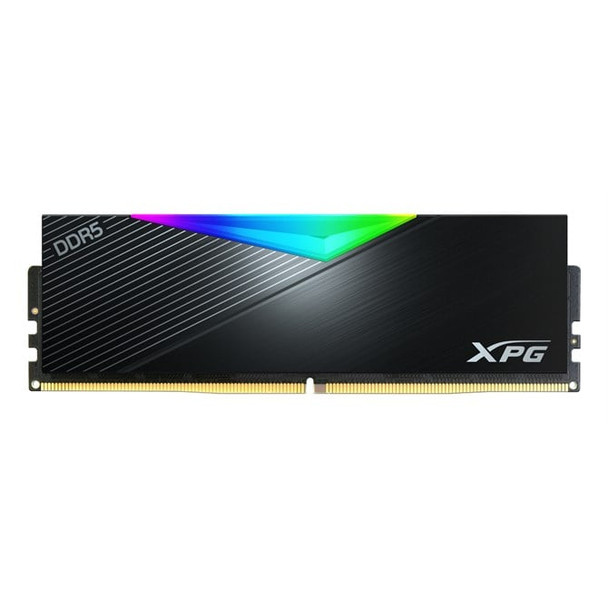
XPG LANCER RGB Memory Module 32 GB 2 X 16 GB DDR5 AX5643216DLARBK
(No reviews yet)
Write a Review
- UPC:
- 4711085940759
- MPN:
- AX5643216DLARBK
- Condition:
- New
- Availability:
- Available with FREE Delivery (usually delivered within 5-7 working days)

Description
A New Speed ??Benchmark in Gaming Memory
The XPG LANCER ushers in the DDR5 era for gaming memory. Reaching frequencies of up to 7200 MT/s, It will give you a major performance boost for gaming and overclocking.
RGB Your Way
Set the RGB lighting the way you want it. Choose from different effects (static, breathing, and comet) or sync the lights with your favorite jams via Music Mode. All this can be done through RGB control software from all the major motherboard brands.
Enhanced Power Management
The XPG LANCER DDR5 features a built-in Power Management IC (PMIC) that enhance power supply stability. It's lower operating voltage also make LANCER more power-efficient than DDR4.
Stability and Reliability
With On-die error correcting code (ECC) this module can correct errors in real-time to provide increased stability and reliability.
Made with High-Quality Materials
High-quality ICs and PCBs ensure uncompromised performance and reliable overclocking, ideal for discerning gamers and overclockers.
AMD EXPO
Support for AMD EXPO (EXtended Profiles for Overclocking) and compatibility with the latest platforms for reliability and stability.
Overclocking Made Easy
With support for Intel XMP 3.0, get overclocking easily without the need to hassle with BIOS settings. There is no need to repeatedly adjust and fine-tune overclocking parameters.
QuikTips: DDR5 vs DDR4 - Appearance
DDR5 U-DIMM modules have the same dimensions and pin count as DDR4 modules. The most obvious difference is the position of the fool-proof notch. Also, DDR5 integrates I/O resistors with CMD/ADD resistors. Also, the appearance of DDR5 modules are cleaner than DDR4. In addition, you can see a PMIC in the center.
QuikTips: DDR5 vs DDR4 - Chip Architecture
DDR5 modules provide two times more capacity than DDR4 by packing in more banks and bank groups. In addition, Burst Length and Prefetch are also doubled. And to ensure data integrity, they feature error correcting code (ECC) technology.
QuikTips: DDR5 vs DDR4 - Performance
The biggest change is that bandwidth and frequency are significantly higher. The ADATA DDR5 memory modules deliver frequencies of up to 4800MT/s and feature bandwidth of 38.4GB/s, which is 50% higher than the DDR4-3200. The maximum frequency is increased 1.63 times compared to DDR4.
Specs
Features
Buffered memory type
Unregistered (unbuffered)
On-Die ECC
CAS latency
Column Address Strobe (CAS) latency, or CL, is the delay time between the moment a memory controller tells the memory module to access a particular memory column on a RAM module, and the moment the data from the given array location is available on the module's output pins. In general, the lower the CAS latency, the better.
32
Internal memory
A computer's memory which is directly accessible to the CPU.
32 GB
Memory layout (modules x size)
How the overall memory of the product is put together, defined by the number of modules and the size.
2 x 16 GB
Internal memory type
The type of internal memory such as RAM, GDDR5.
DDR5
Memory clock speed
The frequency at which the memory (e.g. RAM) runs.
6400 MHz
Component for
What this product is used as a part of (component for).
PC
Memory form factor
Design of the memory e.g. 240-pin DIMM, SO-DIMM.
288-pin DIMM
Memory voltage
The voltage (V) of the memory in the device.
1.35 V
Intel Extreme Memory Profile (XMP)
Intel Extreme Memory Profile (XMP) version
3.0
AMD Extended Profiles for Overclocking (EXPO)
AMD Extended Profiles for Overclocking (EXPO) version
1.0
Features
Cooling type
The method used to cool the device or to cool the air around the device.
Heatsink
Backlight
Product has a built-in light source for its illuminating.
Backlight colour
Multicolour
Operational conditions
Operating temperature (T-T)
The minimum and maximum temperatures at which the product can be safely operated.
0 - 85 °C
Storage temperature (T-T)
The minimum and maximum temperatures at which the product can be safely stored.
-20 - 65 °C
Technical details
Compliance certificates
RoHS
Weight & dimensions
Width
The measurement or extent of something from side to side.
40 mm
Depth
The distance from the front to the back of something.
3.3 mm
Height
The measurement of the product from head to foot or from base to top.
8 mm
Weight
Weight of the product without packaging (net weight). If possible, the net weight is given including standard accessories and supplies. Please note that sometimes the manufacturer leaves out the weight of accessories and/or supplies.
7.32 g
Packaging data
Package type
The type of product package e.g. box.
Box
View AllClose
The XPG LANCER ushers in the DDR5 era for gaming memory. Reaching frequencies of up to 7200 MT/s, It will give you a major performance boost for gaming and overclocking.
RGB Your Way
Set the RGB lighting the way you want it. Choose from different effects (static, breathing, and comet) or sync the lights with your favorite jams via Music Mode. All this can be done through RGB control software from all the major motherboard brands.
Enhanced Power Management
The XPG LANCER DDR5 features a built-in Power Management IC (PMIC) that enhance power supply stability. It's lower operating voltage also make LANCER more power-efficient than DDR4.
Stability and Reliability
With On-die error correcting code (ECC) this module can correct errors in real-time to provide increased stability and reliability.
Made with High-Quality Materials
High-quality ICs and PCBs ensure uncompromised performance and reliable overclocking, ideal for discerning gamers and overclockers.
AMD EXPO
Support for AMD EXPO (EXtended Profiles for Overclocking) and compatibility with the latest platforms for reliability and stability.
Overclocking Made Easy
With support for Intel XMP 3.0, get overclocking easily without the need to hassle with BIOS settings. There is no need to repeatedly adjust and fine-tune overclocking parameters.
QuikTips: DDR5 vs DDR4 - Appearance
DDR5 U-DIMM modules have the same dimensions and pin count as DDR4 modules. The most obvious difference is the position of the fool-proof notch. Also, DDR5 integrates I/O resistors with CMD/ADD resistors. Also, the appearance of DDR5 modules are cleaner than DDR4. In addition, you can see a PMIC in the center.
QuikTips: DDR5 vs DDR4 - Chip Architecture
DDR5 modules provide two times more capacity than DDR4 by packing in more banks and bank groups. In addition, Burst Length and Prefetch are also doubled. And to ensure data integrity, they feature error correcting code (ECC) technology.
QuikTips: DDR5 vs DDR4 - Performance
The biggest change is that bandwidth and frequency are significantly higher. The ADATA DDR5 memory modules deliver frequencies of up to 4800MT/s and feature bandwidth of 38.4GB/s, which is 50% higher than the DDR4-3200. The maximum frequency is increased 1.63 times compared to DDR4.
Specs
Features
Buffered memory type
Unregistered (unbuffered)
On-Die ECC
CAS latency
Column Address Strobe (CAS) latency, or CL, is the delay time between the moment a memory controller tells the memory module to access a particular memory column on a RAM module, and the moment the data from the given array location is available on the module's output pins. In general, the lower the CAS latency, the better.
32
Internal memory
A computer's memory which is directly accessible to the CPU.
32 GB
Memory layout (modules x size)
How the overall memory of the product is put together, defined by the number of modules and the size.
2 x 16 GB
Internal memory type
The type of internal memory such as RAM, GDDR5.
DDR5
Memory clock speed
The frequency at which the memory (e.g. RAM) runs.
6400 MHz
Component for
What this product is used as a part of (component for).
PC
Memory form factor
Design of the memory e.g. 240-pin DIMM, SO-DIMM.
288-pin DIMM
Memory voltage
The voltage (V) of the memory in the device.
1.35 V
Intel Extreme Memory Profile (XMP)
Intel Extreme Memory Profile (XMP) version
3.0
AMD Extended Profiles for Overclocking (EXPO)
AMD Extended Profiles for Overclocking (EXPO) version
1.0
Features
Cooling type
The method used to cool the device or to cool the air around the device.
Heatsink
Backlight
Product has a built-in light source for its illuminating.
Backlight colour
Multicolour
Operational conditions
Operating temperature (T-T)
The minimum and maximum temperatures at which the product can be safely operated.
0 - 85 °C
Storage temperature (T-T)
The minimum and maximum temperatures at which the product can be safely stored.
-20 - 65 °C
Technical details
Compliance certificates
RoHS
Weight & dimensions
Width
The measurement or extent of something from side to side.
40 mm
Depth
The distance from the front to the back of something.
3.3 mm
Height
The measurement of the product from head to foot or from base to top.
8 mm
Weight
Weight of the product without packaging (net weight). If possible, the net weight is given including standard accessories and supplies. Please note that sometimes the manufacturer leaves out the weight of accessories and/or supplies.
7.32 g
Packaging data
Package type
The type of product package e.g. box.
Box
Additional Information
Shipping: |
Usually shipped within 3-5 working days |
Delivery: |
Usually delivered within 5-7 working days |
Related Products
Related Products
Out of stock

XPG LANCER BLADE RGB v Memory Module 32 GB 2 X 16 GB DDR5 AX5U6C3016LARBK
Adata
£454.50
Compact Low-Profile Heatsink Design The LANCER BLADE RGB boasts a low-profile heatsink that fits perfectly in smaller PC cases and avoids interfering with tower CPU coolers. Its sleek geometric...

XPG LANCER BLADE RGB Memory Module 32 GB 2 X 16 GB DDR5 ECC AX5U6C4816LARBK
Adata
£390.44
LANCER BLADE DDR5 SLEEK EFFICIENCY, COMPACT POWER Compact Low-Profile Heatsink Design The LANCER BLADE boasts a low-profile heatsink that fits perfectly in smaller PC cases and avoids...

XPG LANCER BLADE RGB Memory Module 64 GB 2 X 32 GB DDR5 ECC AX5U6C332LABRBK
Adata
£896.37
LANCER BLADE RGB DDR5 SLEEK EFFICIENCY, COMPACT POWER Compact Low-Profile Heatsink Design The LANCER BLADE RGB boasts a low-profile heatsink that fits perfectly in smaller PC cases and avoids...
XPG LANCER BLADE Memory Module 32 GB 2 X 16 GB DDR5 ECC AX564816DTLABBK
Adata
£386.25
LANCER BLADE DDR5 SLEEK EFFICIENCY, COMPACT POWER Compact Low-Profile Heatsink Design The LANCER BLADE boasts a low-profile heatsink that fits perfectly in smaller PC cases and avoids...