
Hanspree
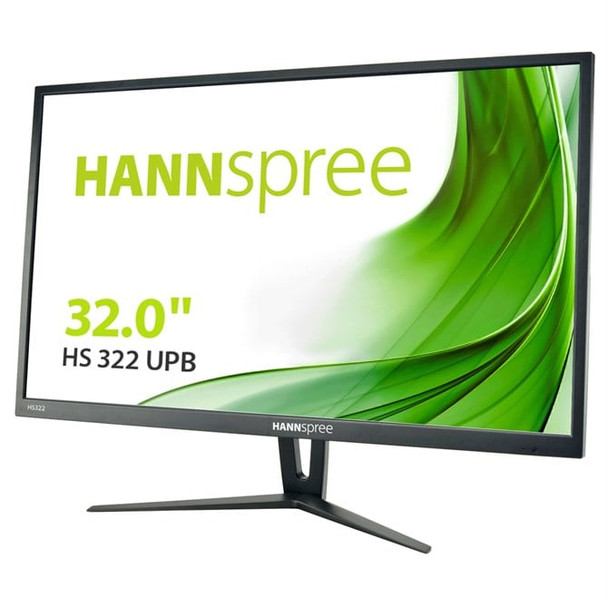
Hannspree HS 322 UPB 81.3 cm 32 2560 x 1440 pixels Quad HD LED Black" HS322UPB
(No reviews yet)
Write a Review
- UPC:
- 4711404023187
- MPN:
- HS322UPB
- Condition:
- New
- Availability:
- Available with FREE Delivery (usually delivered within 5-7 working days)

Description
The HANNspree HS322UPB is a 32-- WQHD 2560-1440 LCD Monitor designed for both office and home use. This monitor offers best-in-class performance with ultra-wide viewing angles. And features a dual digital input interface with DP and HDMI to deliver flexible connectivity options. It also hosts built-in speakers for convenient audio and USB 3.0 HUB with 4 downstream ports for multimedia applications.
Specs
Display
Display diagonal
Size of the display for this product, measured diagonally, usually in inches.
81.3 cm (32")
Display resolution
The number of distinct pixels in each dimension that can be displayed. It is usually quoted as width - height, with the units in pixels: for example, "1024 - 768" means the width is 1024 pixels and the height is 768 pixels. The higher the number of pixels, the sharper the image.
2560 x 1440 pixels
HD type
Type of supported High Definition (e.g. Full HD, 4K Ultra HD).
Quad HD
Native aspect ratio
The aspect ratio is the ratio of the width of an image to its height. The native aspect ratio is the one which the projector/display is particularly designed for. Images shown in native aspect ratio will utilize the entire resolution of the display and achieve maximum brightness. Images shown in other than native aspect ratio will always have less resolution and less brightness than images shown in native aspect ratio.
:9
Display technology
The technology used in the display e.g. plasma, LED.
LED
Panel type
TFT
Touchscreen
A screen of a laptop, smartphone, etc., that responds to touch so you can control the interface using your fingers.
Display brightness (typical)
Display brightness, measured by its Luminance, presented as a figure in nits. Typical brightness ratings for monitors range from 250 to 350 nits with a target value of between 80 to 120 nits being suitable for most displays in a normal viewing environment.
350 cd/m?
Response time
The response time is the time difference between the moment that a source (for example a video card) sends a signal and that equipment (for example a monitor) receives or display the signal. (Used abbreviations: R/F = Rise and Fall.)
5 ms
Anti-glare screen
Always gives an optimal view, even in direct sunlight.
Screen shape
Flat
Aspect ratio
The aspect ratio is the ratio of the width of a shape to its height. For example, 4:3 is common for standard displays and 16:9 is the ratio for Widescreen TV.
:9
Contrast ratio (typical)
The difference in light intensity between the brightest white and the darkest black.
00:1
Contrast ratio (dynamic)
A property of a display system, defined as the ratio of the luminance of the brightest color (white) to that of the darkest color (black) that the system is capable of producing.
80000000:1
Maximum refresh rate
60 Hz
Viewing angle, horizontal
Maximum horizontal angle at which a display can be viewed with acceptable visual performance.
8?
Viewing angle, vertical
Maximum vertical angle at which a display can be viewed with acceptable visual performance.
8?
Display number of colours
1.07 billion colours
Pixel pitch
This is the parameter of a picture tube, which specifies the shortest distance between two dots of the same colour. The principle is: the smaller the dot pitch, the better sharpness of image.
0.272 x 0.272 mm
Horizontal scan range
30 - 138 kHz
Vertical scan range
48 - 75 Hz
Display diagonal (metric)
This is the size of the display screen, measured diagonally.
80 cm
Performance
Flicker-free technology
Low Blue Light technology
Multimedia
Number of speakers
The quantity of speakers included in/with the product.
2
Built-in speaker(s)
The device contains speaker(s) to produce sound.
Built-in camera
The product has an integrated camera.
Design
Product colour
The colour e.g. red, blue, green, black, white.
Black
Ports & interfaces
Built-in USB hub
Whether or not the device features a USB hub to connect more than one other device via USB.
USB hub version
3.2 Gen 1 (3.1 Gen 1)
Number of upstream ports
1
USB Type-A downstream ports quantity
4
DVI port
Digital Visual Interface (DVI) is a video display interface to connect a video source to a display device, such as a computer monitor.
HDMI
HDMI (High-Definition Multimedia Interface) is a compact audio/video interface for transferring uncompressed video data and compressed/uncompressed digital audio data from a HDMI-compliant device ("the source device") to a compatible computer monitor, video projector, digital television, or digital audio device. HDMI is a digital replacement for existing analog video standards.
HDMI ports quantity
The number of sockets (ports) for HDMI connections. HDMI (High-Definition Multimedia Interface) is a compact audio/video interface for transferring uncompressed video data and compressed/uncompressed digital audio data from a HDMI-compliant device ("the source device") to a compatible computer monitor, video projector, digital television, or digital audio device. HDMI is a digital replacement for existing analog video standards.
1
HDMI version
2.0
DisplayPorts quantity
Number of DisplayPorts. A DisplayPort is a digital display interface developed by the Video Electronics Standards Association (VESA). The interface is primarily used to connect a video source to a display device such as a computer monitor, though it can also be used to carry audio, USB, and other forms of data.
1
Ports & interfaces
DisplayPort version
1.2
Audio input
The type of audio input that the device requires, and the connection needed.
Audio output
The type of audio output that the device produces, and the connector(s).
Headphone out
The socket for connecting headphones to the device.
Headphone outputs
Number of sockets /ports where headphones are connected.
1
Headphone connectivity
How headphones connect to a device e.g. wirelessly or via a cable and connector.
3.5 mm
Ergonomics
VESA mounting
Panel mounting interface
The product can be used wih VESA mounting interfaces.
0 x 100 mm
Cable lock slot
Holes on the edge of devices through which a cable lock can be passed, so the device can be locked to a desk etc.
Cable lock slot type
Kensington
Height adjustment
The part of the device that can be adjusted to change the height.
Tilt adjustment
The tilt, which means the angle at which the device is pointing (up or down), can be changed.
Tilt angle range
-5 - 15?
Picture-in-Picture
Picture-in-picture (PiP) is a feature of some television receivers and similar devices. One program (channel) is displayed on the full TV screen at the same time as one or more other programs are displayed in inset windows. Sound is usually from the main program only.
On Screen Display (OSD)
Number of OSD languages
Power
Energy efficiency class (SDR)
G
Energy consumption (SDR) per 1000 hours
38 kWh
Power consumption (typical)
Amount of power consumed by this model, often expressed in watts (W). Typical values that manufacturers give are power consumption when off, standby/suspended mode, typical use, maximum usage.
30.91 W
Power consumption (standby)
The amount of electricity that is consumed when the product is on standby.
0.3 W
Power consumption (off)
0.24 W
AC input voltage
The voltage of the AC electricity that is inputted into the product.
0 - 240 V
AC input frequency
50/65 Hz
European Product Registry for Energy Labelling (EPREL) code
394512
Weight & dimensions
Width (with stand)
724.8 mm
Depth (with stand)
8.2 mm
Height (with stand)
528.2 mm
Weight (with stand)
6.6 kg
Packaging data
Package width
The distance from one side of the packaging to the other.
806 mm
Package depth
The distance from the front to the back of the packaging.
6 mm
Package height
The distance from the top to the bottom of the packaging.
514 mm
Package weight
Weight of the packaged product.
9.3 kg
Packaging content
Stand included
Other features
Picture-by-Picture (PbP)
Logistics data
Harmonized System (HS) code
85285210
View AllClose
Specs
Display
Display diagonal
Size of the display for this product, measured diagonally, usually in inches.
81.3 cm (32")
Display resolution
The number of distinct pixels in each dimension that can be displayed. It is usually quoted as width - height, with the units in pixels: for example, "1024 - 768" means the width is 1024 pixels and the height is 768 pixels. The higher the number of pixels, the sharper the image.
2560 x 1440 pixels
HD type
Type of supported High Definition (e.g. Full HD, 4K Ultra HD).
Quad HD
Native aspect ratio
The aspect ratio is the ratio of the width of an image to its height. The native aspect ratio is the one which the projector/display is particularly designed for. Images shown in native aspect ratio will utilize the entire resolution of the display and achieve maximum brightness. Images shown in other than native aspect ratio will always have less resolution and less brightness than images shown in native aspect ratio.
:9
Display technology
The technology used in the display e.g. plasma, LED.
LED
Panel type
TFT
Touchscreen
A screen of a laptop, smartphone, etc., that responds to touch so you can control the interface using your fingers.
Display brightness (typical)
Display brightness, measured by its Luminance, presented as a figure in nits. Typical brightness ratings for monitors range from 250 to 350 nits with a target value of between 80 to 120 nits being suitable for most displays in a normal viewing environment.
350 cd/m?
Response time
The response time is the time difference between the moment that a source (for example a video card) sends a signal and that equipment (for example a monitor) receives or display the signal. (Used abbreviations: R/F = Rise and Fall.)
5 ms
Anti-glare screen
Always gives an optimal view, even in direct sunlight.
Screen shape
Flat
Aspect ratio
The aspect ratio is the ratio of the width of a shape to its height. For example, 4:3 is common for standard displays and 16:9 is the ratio for Widescreen TV.
:9
Contrast ratio (typical)
The difference in light intensity between the brightest white and the darkest black.
00:1
Contrast ratio (dynamic)
A property of a display system, defined as the ratio of the luminance of the brightest color (white) to that of the darkest color (black) that the system is capable of producing.
80000000:1
Maximum refresh rate
60 Hz
Viewing angle, horizontal
Maximum horizontal angle at which a display can be viewed with acceptable visual performance.
8?
Viewing angle, vertical
Maximum vertical angle at which a display can be viewed with acceptable visual performance.
8?
Display number of colours
1.07 billion colours
Pixel pitch
This is the parameter of a picture tube, which specifies the shortest distance between two dots of the same colour. The principle is: the smaller the dot pitch, the better sharpness of image.
0.272 x 0.272 mm
Horizontal scan range
30 - 138 kHz
Vertical scan range
48 - 75 Hz
Display diagonal (metric)
This is the size of the display screen, measured diagonally.
80 cm
Performance
Flicker-free technology
Low Blue Light technology
Multimedia
Number of speakers
The quantity of speakers included in/with the product.
2
Built-in speaker(s)
The device contains speaker(s) to produce sound.
Built-in camera
The product has an integrated camera.
Design
Product colour
The colour e.g. red, blue, green, black, white.
Black
Ports & interfaces
Built-in USB hub
Whether or not the device features a USB hub to connect more than one other device via USB.
USB hub version
3.2 Gen 1 (3.1 Gen 1)
Number of upstream ports
1
USB Type-A downstream ports quantity
4
DVI port
Digital Visual Interface (DVI) is a video display interface to connect a video source to a display device, such as a computer monitor.
HDMI
HDMI (High-Definition Multimedia Interface) is a compact audio/video interface for transferring uncompressed video data and compressed/uncompressed digital audio data from a HDMI-compliant device ("the source device") to a compatible computer monitor, video projector, digital television, or digital audio device. HDMI is a digital replacement for existing analog video standards.
HDMI ports quantity
The number of sockets (ports) for HDMI connections. HDMI (High-Definition Multimedia Interface) is a compact audio/video interface for transferring uncompressed video data and compressed/uncompressed digital audio data from a HDMI-compliant device ("the source device") to a compatible computer monitor, video projector, digital television, or digital audio device. HDMI is a digital replacement for existing analog video standards.
1
HDMI version
2.0
DisplayPorts quantity
Number of DisplayPorts. A DisplayPort is a digital display interface developed by the Video Electronics Standards Association (VESA). The interface is primarily used to connect a video source to a display device such as a computer monitor, though it can also be used to carry audio, USB, and other forms of data.
1
Ports & interfaces
DisplayPort version
1.2
Audio input
The type of audio input that the device requires, and the connection needed.
Audio output
The type of audio output that the device produces, and the connector(s).
Headphone out
The socket for connecting headphones to the device.
Headphone outputs
Number of sockets /ports where headphones are connected.
1
Headphone connectivity
How headphones connect to a device e.g. wirelessly or via a cable and connector.
3.5 mm
Ergonomics
VESA mounting
Panel mounting interface
The product can be used wih VESA mounting interfaces.
0 x 100 mm
Cable lock slot
Holes on the edge of devices through which a cable lock can be passed, so the device can be locked to a desk etc.
Cable lock slot type
Kensington
Height adjustment
The part of the device that can be adjusted to change the height.
Tilt adjustment
The tilt, which means the angle at which the device is pointing (up or down), can be changed.
Tilt angle range
-5 - 15?
Picture-in-Picture
Picture-in-picture (PiP) is a feature of some television receivers and similar devices. One program (channel) is displayed on the full TV screen at the same time as one or more other programs are displayed in inset windows. Sound is usually from the main program only.
On Screen Display (OSD)
Number of OSD languages
Power
Energy efficiency class (SDR)
G
Energy consumption (SDR) per 1000 hours
38 kWh
Power consumption (typical)
Amount of power consumed by this model, often expressed in watts (W). Typical values that manufacturers give are power consumption when off, standby/suspended mode, typical use, maximum usage.
30.91 W
Power consumption (standby)
The amount of electricity that is consumed when the product is on standby.
0.3 W
Power consumption (off)
0.24 W
AC input voltage
The voltage of the AC electricity that is inputted into the product.
0 - 240 V
AC input frequency
50/65 Hz
European Product Registry for Energy Labelling (EPREL) code
394512
Weight & dimensions
Width (with stand)
724.8 mm
Depth (with stand)
8.2 mm
Height (with stand)
528.2 mm
Weight (with stand)
6.6 kg
Packaging data
Package width
The distance from one side of the packaging to the other.
806 mm
Package depth
The distance from the front to the back of the packaging.
6 mm
Package height
The distance from the top to the bottom of the packaging.
514 mm
Package weight
Weight of the packaged product.
9.3 kg
Packaging content
Stand included
Other features
Picture-by-Picture (PbP)
Logistics data
Harmonized System (HS) code
85285210
Additional Information
Shipping: |
Usually shipped within 3-5 working days |
Delivery: |
Usually delivered within 5-7 working days |
Related Products
Related Products
Out of stock

Samsung LS32A600NWUXEN 81.3 cm 32" 2560 x 1440 LS32A600NWUXEN
Samsung
£488.43
81.3 cm (32") 2560 x 1440 pixels Quad HD Black Samsung