
Msi
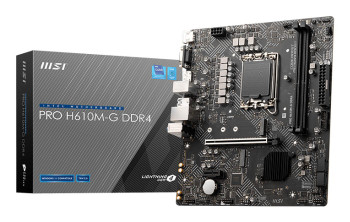
MSI PRO H610M-G DDR4 Motherboard Intel H610 LGA 1700 Micro ATX PRO H610M-G DDR4
(No reviews yet)
Write a Review

- UPC:
- 4719072925024
- MPN:
- PRO H610M-G DDR4
- Condition:
- New
- Availability:
- Available with FREE Delivery (usually delivered within 2-3 working days)

Description
PRO series helps users work smarter by delivering an efficient and productive experience. Featuring stable functionality and high-quality assembly, PRO series motherboards provide not only optimized professional workflows but also less troubleshooting and longevity.
FROZR AI COOLING
Detecting CPU & GPU temperatures and automatically adjusting fan duty of system fans to a proper value by adopting MSI AI ENGINE.
LIGHTNING GEN 4 PCI-E
MSI lightning Gen 4 PCI-E is the latest and the fastest PCI-E data transfer solution with 64GB/s of transfer bandwidth that has doubled compared to its previous generation. PCIe 4.0 maintains both backward and forward compatibility with older and newer specifications. Optimized by steel armor design, your motherboards can support the weight of heavy graphics cards.
Specs
Processor
Processor manufacturer
The manufacturer that produced the processor.
Intel
Processor socket
Mechanical component(s) that provides mechanical and electrical connections between a microprocessor and a printed circuit board (PCB). This allows the processor to be replaced without soldering.
LGA 1700
Compatible processor series
A processor which is compatible with this device, belongs to a 'series' which is part of 'family' e.g Celeron D, Celeron G, Celeron M, or, in some cases, is the same as 'family'.
Intel- Core- i9
Supported processor sockets
The sockets (plugs) for processors that are supported (can be used) by the device.
LGA 1700
Memory
Supported memory types
Types of memory which can be used with the product.
DDR4-SDRAM
Number of memory slots
2
Memory slots type
A memory slot, also known as a memory socket or RAM slot, is what allows computer memory (RAM) to be inserted into the computer. Depending on the motherboard, there will usually be 2 to 4 memory slots (sometimes more on high-end motherboards). The most common types of RAM are SDRAM and DDR for desktop computers and SODIMM for laptop computers, each having various types and speeds.
DIMM
Memory channels
Dual-channel
ECC ?ompatibility
Non-ECC
Supported memory clock speeds
Memory clock speed is the time it takes for a computer to complete basic operations. It refers to the computer's processing speed and is measured in hertz. It is however not such a reliable measure of a computer's speed as it doesn't take into account other factors like RAM and cache size.
2133, 2666, 2933, 3200 MHz
Maximum internal memory
The maximum internal memory which is available in the product.
64 GB
Storage controllers
Supported storage drive types
The type of storage drives the device is compatible with.
SSD
Supported storage drive interfaces
M.2, SATA III
Graphics
Parallel processing technology support
Parallel processing technology is the simultaneous use of more than one CPU or processor core to execute a program or multiple computational threads. Ideally, parallel processing makes programs run faster because there are more engines (CPUs or Cores) running it. In practice, it is often difficult to divide a program in such a way that separate CPUs or cores can execute different portions without interfering with each other. Most computers have just one CPU, but some models have several, and multi-core processor chips are becoming the norm. There are even computers with thousands of CPUs.
Not supported
DirectX version
DirectX is a collection of APIs (application programming interfaces) for easily handling tasks related to game programming on the Microsoft Windows operating system.
.0
Internal I/O
USB 2.0 connectors
The end of a cable with a USB 2.0 connector. USB 2.0 was released in April 2000 (now called "Hi-Speed"), adding higher maximum signaling rate of 480 Mbit/s (effective throughput up to 35 MB/s or 280 Mbit/s), in addition to the "USB 1.x Full Speed" signaling rate of 12 Mbit/s. USB 2.0 connectors are usually colored black.
2
USB 3.2 Gen 1 (3.1 Gen 1) connectors
This is a connector (normally attached to a cable) for USB 3.0. USB 3.0 is the second major revision of the Universal Serial Bus (USB) standard for computer connectivity. First introduced in 2008, USB 3.0 adds a new transfer mode called "SuperSpeed," (distinguishable from USB 2.0 by either the blue colour of the port or the initials SS) capable of transferring data at up to 5Gbit/s-more than ten times as fast as the 480 Mbit/s top speed of USB 2.0.
2
Number of SATA III connectors
Serial ATA (Advanced Technology Attachment) (SATA) is a computer bus interface that connects host bus adapters to mass storage devices such as hard disk drives and optical drives. SATA III (revision 3.x) interface, formally known as SATA 6Gb/s, is a third generation SATA interface running at 6.0Gb/s. The bandwidth throughput, which is supported by the interface, is up to 600MB/s. This interface is backwards compatible with SATA 3 Gb/s interface.
4
Front panel audio connector
ATX Power connector (24-pin)
CPU fan connector
TPM connector
V power connector
Rear panel I/O ports
USB 2.0 ports quantity
Number of USB 2.0 ports (connecting interfaces) in the device. USB 2.0 was released in April 2000 (now called "Hi-Speed"), adding higher maximum signaling rate of 480 Mbit/s (effective throughput up to 35 MB/s or 280 Mbit/s), USB 2.0 ports are usually black.
4
USB 3.2 Gen 1 (3.1 Gen 1) Type-A ports quantity
2
Rear panel I/O ports
Ethernet LAN (RJ-45) ports
Number of Ethernet LAN (RJ-45) ports (connecting interfaces) in the device. Ethernet LAN (RJ-45) ports allow a computer to connect to the ethernet.
1
VGA (D-Sub) ports quantity
Number of VGA (D-Sub) ports (connecting interfaces) in the device. The VGA (D-Sub) connector is a 15 pin connector between a computer and a monitor. It was first introduced in 1987 by IBM.
1
HDMI ports quantity
The number of sockets (ports) for HDMI connections. HDMI (High-Definition Multimedia Interface) is a compact audio/video interface for transferring uncompressed video data and compressed/uncompressed digital audio data from a HDMI-compliant device ("the source device") to a compatible computer monitor, video projector, digital television, or digital audio device. HDMI is a digital replacement for existing analog video standards.
1
DisplayPorts quantity
Number of DisplayPorts. A DisplayPort is a digital display interface developed by the Video Electronics Standards Association (VESA). The interface is primarily used to connect a video source to a display device such as a computer monitor, though it can also be used to carry audio, USB, and other forms of data.
1
Network
Ethernet LAN
An Ethernet LAN (Local Area Network) interface is present, for a wired conection via a cable.
Ethernet interface type
Gigabit Ethernet
Wi-Fi
Popular technology that allows an electronic device to exchange data or connect to the internet wirelessly using radio waves.
Features
Motherboard chipset
The chipset connects the microprocessor to the rest of the motherboard.
Intel H610
Audio chip
Realtek ALC897
Audio output channels
An audio output channel is an electric circuit which acts as a path for a signal produced by a device. A device may have several audio output channels.
7.1 channels
Component for
What this product is used as a part of (component for).
PC
Motherboard form factor
Design of the motherboard (ATX, BTX etc).
micro ATX
Motherboard chipset family
The category of motherboard chipset e.g. Intel, AMD.
Intel
Windows operating systems supported
Windows vesions wich can be used with the device.
Windows 10, Windows 11
BIOS
BIOS type
The BIOS (Basic Input/Output System) initializes and tests system hardware components, and loads a bootloader or an operating system from a mass memory device. The BIOS additionally provides abstraction layer for the hardware, i.e. a consistent way for application programs and operating systems to interact with the keyboard, display, and other input/output devices. There are several types of BIOS, including the motherboard ROM BIOS, video BIOS, drive controller BIOS, network adapter BIOS, and SCSI adapter BIOS.
UEFI AMI
Logistics data
Harmonized System (HS) code
84733020
Weight & dimensions
Width
The measurement or extent of something from side to side.
211 mm
Depth
The distance from the front to the back of something.
244 mm
Height
The measurement of the product from head to foot or from base to top.
65 mm
Packaging content
Cables included
SATA
Drivers included
Other features
Weight
Weight of the product without packaging (net weight). If possible, the net weight is given including standard accessories and supplies. Please note that sometimes the manufacturer leaves out the weight of accessories and/or supplies.
764 g
View AllClose
FROZR AI COOLING
Detecting CPU & GPU temperatures and automatically adjusting fan duty of system fans to a proper value by adopting MSI AI ENGINE.
LIGHTNING GEN 4 PCI-E
MSI lightning Gen 4 PCI-E is the latest and the fastest PCI-E data transfer solution with 64GB/s of transfer bandwidth that has doubled compared to its previous generation. PCIe 4.0 maintains both backward and forward compatibility with older and newer specifications. Optimized by steel armor design, your motherboards can support the weight of heavy graphics cards.
Specs
Processor
Processor manufacturer
The manufacturer that produced the processor.
Intel
Processor socket
Mechanical component(s) that provides mechanical and electrical connections between a microprocessor and a printed circuit board (PCB). This allows the processor to be replaced without soldering.
LGA 1700
Compatible processor series
A processor which is compatible with this device, belongs to a 'series' which is part of 'family' e.g Celeron D, Celeron G, Celeron M, or, in some cases, is the same as 'family'.
Intel- Core- i9
Supported processor sockets
The sockets (plugs) for processors that are supported (can be used) by the device.
LGA 1700
Memory
Supported memory types
Types of memory which can be used with the product.
DDR4-SDRAM
Number of memory slots
2
Memory slots type
A memory slot, also known as a memory socket or RAM slot, is what allows computer memory (RAM) to be inserted into the computer. Depending on the motherboard, there will usually be 2 to 4 memory slots (sometimes more on high-end motherboards). The most common types of RAM are SDRAM and DDR for desktop computers and SODIMM for laptop computers, each having various types and speeds.
DIMM
Memory channels
Dual-channel
ECC ?ompatibility
Non-ECC
Supported memory clock speeds
Memory clock speed is the time it takes for a computer to complete basic operations. It refers to the computer's processing speed and is measured in hertz. It is however not such a reliable measure of a computer's speed as it doesn't take into account other factors like RAM and cache size.
2133, 2666, 2933, 3200 MHz
Maximum internal memory
The maximum internal memory which is available in the product.
64 GB
Storage controllers
Supported storage drive types
The type of storage drives the device is compatible with.
SSD
Supported storage drive interfaces
M.2, SATA III
Graphics
Parallel processing technology support
Parallel processing technology is the simultaneous use of more than one CPU or processor core to execute a program or multiple computational threads. Ideally, parallel processing makes programs run faster because there are more engines (CPUs or Cores) running it. In practice, it is often difficult to divide a program in such a way that separate CPUs or cores can execute different portions without interfering with each other. Most computers have just one CPU, but some models have several, and multi-core processor chips are becoming the norm. There are even computers with thousands of CPUs.
Not supported
DirectX version
DirectX is a collection of APIs (application programming interfaces) for easily handling tasks related to game programming on the Microsoft Windows operating system.
.0
Internal I/O
USB 2.0 connectors
The end of a cable with a USB 2.0 connector. USB 2.0 was released in April 2000 (now called "Hi-Speed"), adding higher maximum signaling rate of 480 Mbit/s (effective throughput up to 35 MB/s or 280 Mbit/s), in addition to the "USB 1.x Full Speed" signaling rate of 12 Mbit/s. USB 2.0 connectors are usually colored black.
2
USB 3.2 Gen 1 (3.1 Gen 1) connectors
This is a connector (normally attached to a cable) for USB 3.0. USB 3.0 is the second major revision of the Universal Serial Bus (USB) standard for computer connectivity. First introduced in 2008, USB 3.0 adds a new transfer mode called "SuperSpeed," (distinguishable from USB 2.0 by either the blue colour of the port or the initials SS) capable of transferring data at up to 5Gbit/s-more than ten times as fast as the 480 Mbit/s top speed of USB 2.0.
2
Number of SATA III connectors
Serial ATA (Advanced Technology Attachment) (SATA) is a computer bus interface that connects host bus adapters to mass storage devices such as hard disk drives and optical drives. SATA III (revision 3.x) interface, formally known as SATA 6Gb/s, is a third generation SATA interface running at 6.0Gb/s. The bandwidth throughput, which is supported by the interface, is up to 600MB/s. This interface is backwards compatible with SATA 3 Gb/s interface.
4
Front panel audio connector
ATX Power connector (24-pin)
CPU fan connector
TPM connector
V power connector
Rear panel I/O ports
USB 2.0 ports quantity
Number of USB 2.0 ports (connecting interfaces) in the device. USB 2.0 was released in April 2000 (now called "Hi-Speed"), adding higher maximum signaling rate of 480 Mbit/s (effective throughput up to 35 MB/s or 280 Mbit/s), USB 2.0 ports are usually black.
4
USB 3.2 Gen 1 (3.1 Gen 1) Type-A ports quantity
2
Rear panel I/O ports
Ethernet LAN (RJ-45) ports
Number of Ethernet LAN (RJ-45) ports (connecting interfaces) in the device. Ethernet LAN (RJ-45) ports allow a computer to connect to the ethernet.
1
VGA (D-Sub) ports quantity
Number of VGA (D-Sub) ports (connecting interfaces) in the device. The VGA (D-Sub) connector is a 15 pin connector between a computer and a monitor. It was first introduced in 1987 by IBM.
1
HDMI ports quantity
The number of sockets (ports) for HDMI connections. HDMI (High-Definition Multimedia Interface) is a compact audio/video interface for transferring uncompressed video data and compressed/uncompressed digital audio data from a HDMI-compliant device ("the source device") to a compatible computer monitor, video projector, digital television, or digital audio device. HDMI is a digital replacement for existing analog video standards.
1
DisplayPorts quantity
Number of DisplayPorts. A DisplayPort is a digital display interface developed by the Video Electronics Standards Association (VESA). The interface is primarily used to connect a video source to a display device such as a computer monitor, though it can also be used to carry audio, USB, and other forms of data.
1
Network
Ethernet LAN
An Ethernet LAN (Local Area Network) interface is present, for a wired conection via a cable.
Ethernet interface type
Gigabit Ethernet
Wi-Fi
Popular technology that allows an electronic device to exchange data or connect to the internet wirelessly using radio waves.
Features
Motherboard chipset
The chipset connects the microprocessor to the rest of the motherboard.
Intel H610
Audio chip
Realtek ALC897
Audio output channels
An audio output channel is an electric circuit which acts as a path for a signal produced by a device. A device may have several audio output channels.
7.1 channels
Component for
What this product is used as a part of (component for).
PC
Motherboard form factor
Design of the motherboard (ATX, BTX etc).
micro ATX
Motherboard chipset family
The category of motherboard chipset e.g. Intel, AMD.
Intel
Windows operating systems supported
Windows vesions wich can be used with the device.
Windows 10, Windows 11
BIOS
BIOS type
The BIOS (Basic Input/Output System) initializes and tests system hardware components, and loads a bootloader or an operating system from a mass memory device. The BIOS additionally provides abstraction layer for the hardware, i.e. a consistent way for application programs and operating systems to interact with the keyboard, display, and other input/output devices. There are several types of BIOS, including the motherboard ROM BIOS, video BIOS, drive controller BIOS, network adapter BIOS, and SCSI adapter BIOS.
UEFI AMI
Logistics data
Harmonized System (HS) code
84733020
Weight & dimensions
Width
The measurement or extent of something from side to side.
211 mm
Depth
The distance from the front to the back of something.
244 mm
Height
The measurement of the product from head to foot or from base to top.
65 mm
Packaging content
Cables included
SATA
Drivers included
Other features
Weight
Weight of the product without packaging (net weight). If possible, the net weight is given including standard accessories and supplies. Please note that sometimes the manufacturer leaves out the weight of accessories and/or supplies.
764 g
Additional Information
Shipping: |
Usually shipped within 1 working day |
Delivery: |
Usually delivered within 2-3 working days |
Related Products
Related Products
MSI PRO H610M-G DDR4 Motherboard Intel H610 Lga PRO H610M-G DDR4
Msi
£90.82
PRO series helps users work smarter by delivering an efficient and productive experience. Featuring stable functionality and high-quality assembly, PRO series motherboards provide not only optimized...

MSI PRO H610M-G Ddr4 Motherboard Intel H610 PRO H610M-G
Msi
£85.17
PRO series helps users work smarter by delivering an efficient and productive experience. Featuring stable functionality and high-quality assembly, PRO series motherboards provide not only optimized...